Red light therapy: what the evidence actually says
Updated · Editorial guide, not medical advice
Photobiomodulation has genuine positive findings for selected clinical applications. A 2025 umbrella review included 204 randomized trials, while newer reviews underline how strongly results depend on the condition, device and dose. Those findings deserve attention without being presented as a promise for every full-body bed session.
How it's thought to work
The leading theory is that light is absorbed by mitochondrial enzymes such as cytochrome c oxidase, briefly changing cellular energy production and signalling. Researchers are still working out the details.
Where the evidence is stronger — and weaker
A 2025 expert consensus in the Journal of the American Academy of Dermatology supports photobiomodulation for some defined clinical uses. Trials for skin ageing and hair thinning are promising but vary in device and dose.
Claims that full-body beds aid weight loss, ‘detox’, boost immunity or speed recovery are not well supported. The American Academy of Dermatology also notes results depend heavily on the device and that at-home and salon devices differ from clinical ones.
Who should check first
Speak to your doctor first if you take photosensitising medication or have a light-sensitive condition, are pregnant, have or are being investigated for skin cancer in the area, or have a photosensitive seizure disorder (some devices pulse).
Eye protection is used as directed by the device manufacturer. Not every precaution is absolute — many simply need a conversation first.
The science of feeling better
Light, cells & possibility
Red and near-infrared light is one of the most researched light therapies — with encouraging trials on muscle recovery and early whole-body findings on sleep.
- A warm, glowing and restful light session
- Lie back and switch off for a few minutes
- Easy to pair with other sessions
Good to know: Muscle-recovery results come from targeted devices, not full-body beds; whole-body studies have not shown performance benefits.
How it may work
Photobiomodulation uses red or near-infrared light as a biological signal. One leading explanation involves light-sensitive mitochondrial pathways, which can alter cellular energy and signalling. The response depends on wavelength, dose, tissue and timing — more light is not automatically better.
What researchers are exploring
Researchers study particular outcomes such as hair density, skin changes, pain and tissue repair, using different devices and protocols. A positive result for one condition is not proof of a general full-body wellness effect.
Studies vs. your visit here
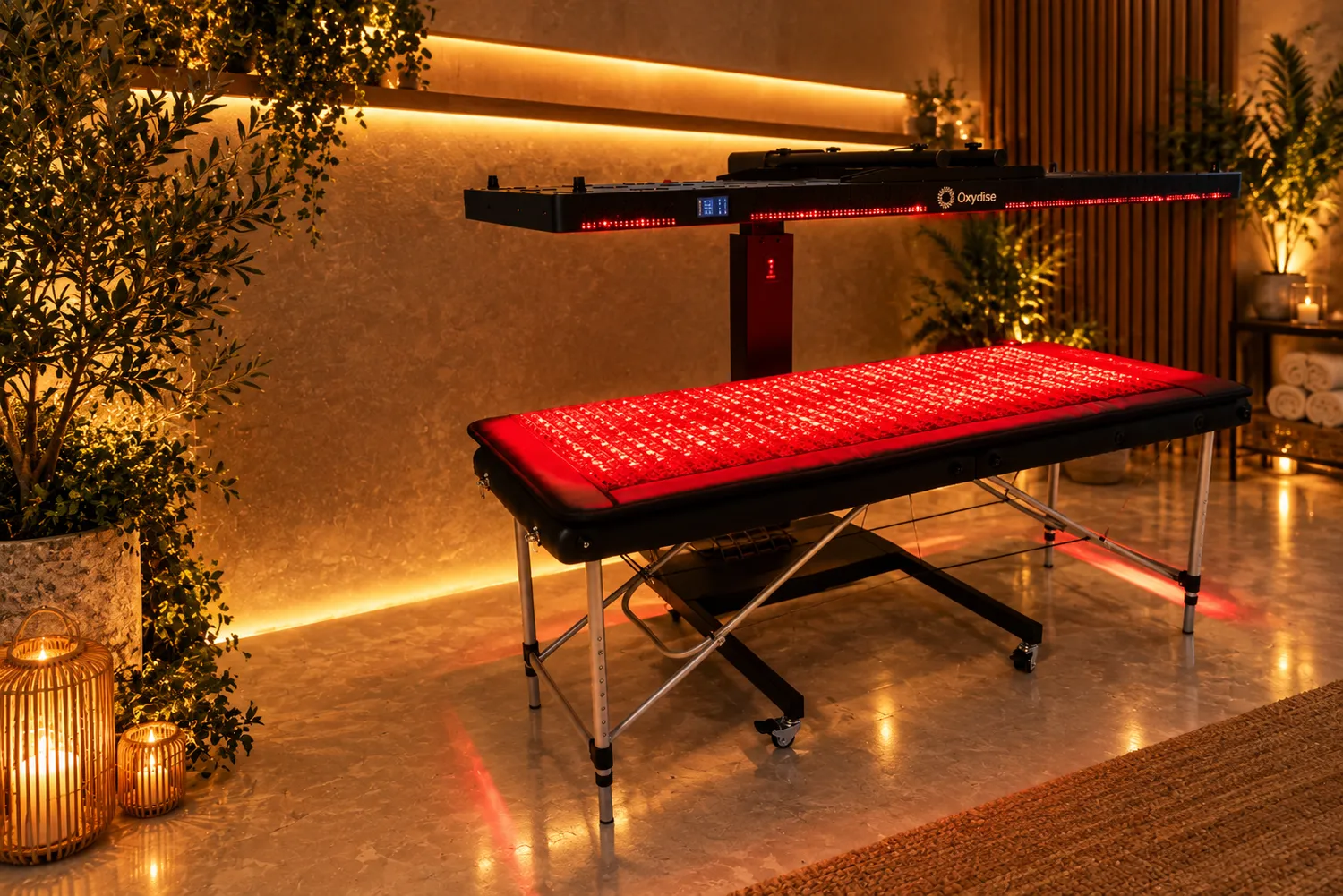
Our red light bed offers a quiet light-based experience. Its device model, wavelengths, dose and eye-protection guidance still need verification before any clinical research can be matched to this equipment. Photosensitivity, relevant medication, pregnancy, cancer in the exposure field and photosensitive seizures require appropriate review.
Key research, in brief
Review · 17 May 2024
34 randomized trials: targeted light before exercise improved muscle endurance and strength recovery
Meta-analysis of 34 randomized controlled trials in healthy exercising adults; light applied locally to muscles before exercise
Original source: Can pre-exercise photobiomodulation improve muscle endurance and promote recovery from muscle strength and injuries in people with different activity levels? A meta-analysis of randomized controlled trials — B.M. Li, D.Y. Qiu, P.S. Ni et al.What the study found
Pre-exercise light therapy improved muscle endurance (moderate effect) and recovery of muscle strength, and lowered creatine kinase, a marker of muscle damage. Benefits were seen in athletes and inactive people, but not in the physically active group.
What we still don't know
These trials used targeted lasers or LED pads on specific muscles, not a full-body bed, so the results cannot be assumed for our red light bed. Effect sizes were small to moderate.
Review · 30 January 2025
Whole-body light beds: early signs of better sleep quality
Systematic review: five studies, 105 physically active participants using whole-body light beds
Original source: A systematic review on whole-body photobiomodulation for exercise performance and recovery — Álvarez-Martínez and BordenWhat the study found
Two studies reported better sleep quality, including higher melatonin and lower night-time heart rate, with whole-body light sessions.
What we still don't know
None of the five studies found a benefit for exercise performance or fatigue markers. Studies were few and small, and the sleep findings need confirming.
Review · 2025
International expert panel supports light therapy for selected medical uses — not wellness beds
Literature search (June 2022) and international Delphi expert consensus
Original source: Evidence-based consensus on the clinical application of photobiomodulation — Jalal Maghfour, Jessica Mineroff, David M. Ozog and colleaguesWhat the study found
The panel endorsed selected clinical applications including androgenetic alopecia, peripheral neuropathy, certain ulcers and acute radiation dermatitis. This is substantive support for particular uses of PBM, not a claim that every red light application is equivalent.
What we still don't know
Consensus is not a new randomized trial. The search preceded publication by nearly three years; protocols, patient groups and devices vary. Recommendations do not establish outcomes for this clinic’s bed.
Review · 6 August 2025
204 randomized trials reviewed: meaningful effects for 12 of 35 specific outcomes
Umbrella review: 15 meta-analyses, 204 randomized trials, over 9,000 participants
Original source: Effects of photobiomodulation on multiple health outcomes: an umbrella review of randomized clinical trials — Yejun Son, Hyeri Lee, Seungyeong Yu and colleaguesWhat the study found
Across 35 endpoints in 15 conditions, 12 outcomes showed statistically significant effects. For example, burning-mouth-syndrome pain showed a moderate-certainty benefit. The positive signals are condition-specific, not a universal wellness effect.
What we still don't know
Searches ended in December 2023. This synthesises earlier reviews rather than adding a new trial; certainty and protocols differ. Trial counts are not proof of benefit for a whole-body bed or every visitor.
Review · 15 October 2026
100 reviews of light therapy: 62 reached favourable conclusions in specific settings
Umbrella review of 100 systematic reviews; 790 unique eligible primary studies
Original source: Umbrella review of low-level light therapy: evidence across clinical conditions — Eunhye Song, Lin Ang, Mi Hong Yim, Sunmi Choi and Jihye KimWhat the study found
62 reviews reached favourable conclusions, 34 neutral/mixed and 4 unclear. Oncology-related complications had the highest proportion of favourable review conclusions, highlighting the importance of specific clinical contexts.
What we still don't know
These are review-level conclusions, not the percentage of patients helped or a pooled treatment effect. Primary studies overlap across reviews; adverse-event reporting was uneven. The publisher record was verified; the supplied PMC identifier mapping was not independently confirmed.
Related therapies
Sources
- Maghfour J, et al. Evidence-based consensus on the clinical application of photobiomodulation. J Am Acad Dermatol. 2025.
- Son Y, Lee H, Yu S, et al. Effects of photobiomodulation on multiple health outcomes: umbrella review of randomized clinical trials. Systematic Reviews, 2025.
- Song E, Ang L, Yim MH, Choi S, Kim J. Umbrella review of low-level light therapy: evidence across clinical conditions. 2026.
- American Academy of Dermatology. Red light therapy: Is it safe? Does it work?