
Recover & Recharge
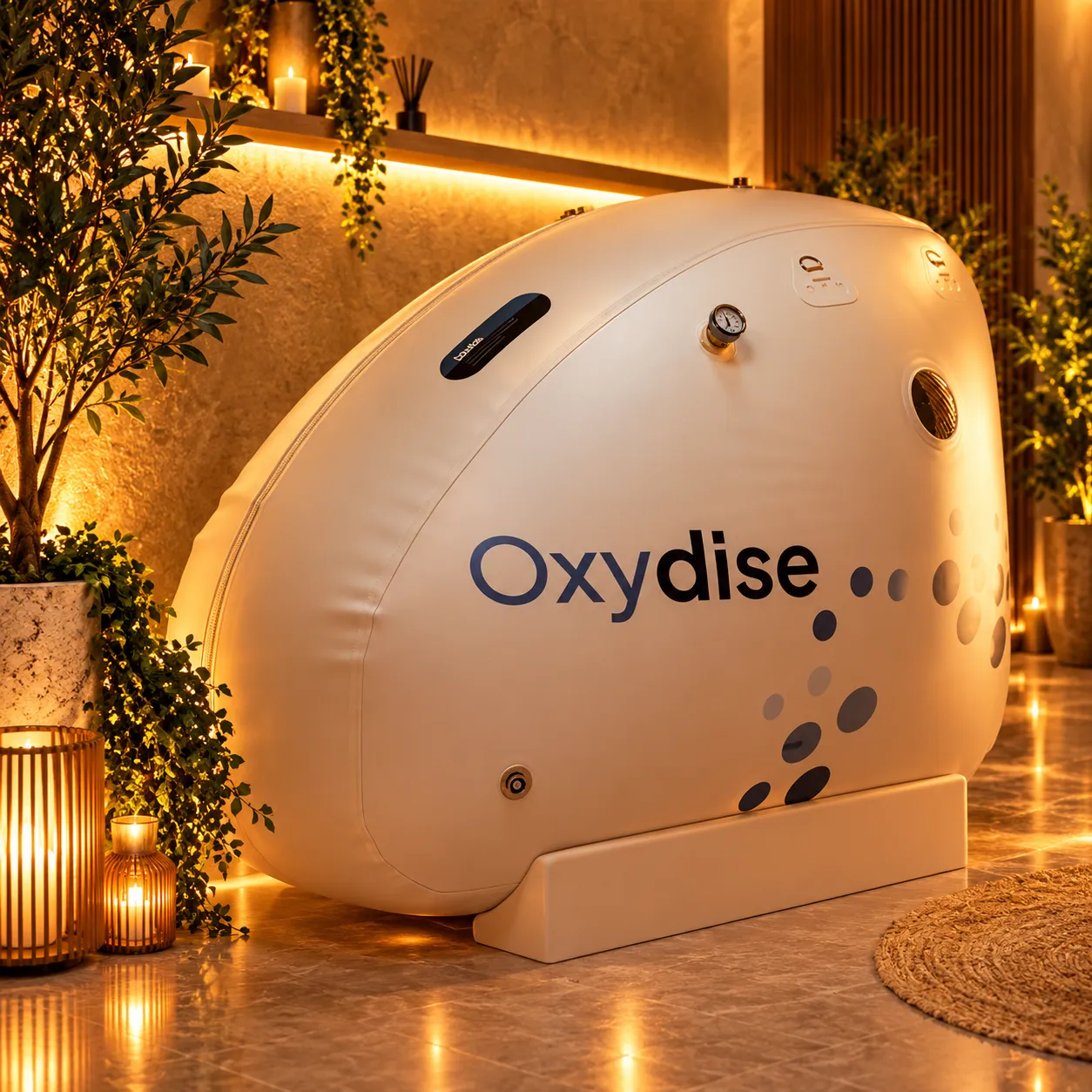
Seated Hyperbaric Oxygen Chamber
Sit, rest and breathe in a quiet, pressurised space.
A hyperbaric chamber is an enclosed space where the air pressure is raised above normal; ours is a seated design where you sit upright and rest.
Suitability screening required. Before your first session we'll ask some health questions. This is a wellness service — it is not medically prescribed or clinically supervised, and some people will be advised not to use it. See Science & Safety.
What is it?
Our chamber is a sitting-style unit — you remain upright, comfortable and able to read or rest.
This is a wellness service. It is not the same as hospital hyperbaric oxygen therapy delivered under medical supervision for specific conditions.
What happens during your visit
- 01Before your first session we'll go through a suitability questionnaire with you.
- 02Our team explains how the chamber works and how to equalise your ears as pressure changes.
- 03You sit and rest inside; staff remain on hand throughout and you can ask to stop at any time.
How long is a session?
Duration to confirm
Session length is shown when you choose a time in our booking calendar.
Comfort & what to bring
- Loose, comfortable cotton clothing
- Please remove jewellery and leave electronics outside — we'll confirm the full list when you book
Who might enjoy it
- Active adults curious about recovery routines
- People who enjoy a quiet, seated rest
Safety at a glance
- Suitability screening is required before your first session.
- Untreated pneumothorax (collapsed lung) is an absolute contraindication. Lung disease including COPD, ear or sinus infection, inability to equalise your ears, recent ear, chest or eye surgery, gas in the eye after surgery, claustrophobia, some medicines and diabetes all need review first.
- Oxygen increases fire risk: no lighters, electronics, oils or flammable products near the chamber.
- This is a wellness service. It is not medically prescribed or supervised by a doctor and is not a replacement for clinical hyperbaric treatment.
Science & Safety
Hyperbaric Chamber: what we know
UHMS defines hyperbaric oxygen therapy around at least 95% medical-grade oxygen above 1 atmosphere absolute (ATA), while scientifically supported treatment protocols are usually delivered at 1.9–3.0 ATA. Pressure and oxygen delivery distinguish those protocols from mild wellness exposures. Our chamber operates at 1.5 ATA (owner-confirmed), below that clinical range; its oxygen concentration and delivery method are not yet confirmed.
How it's thought to work
Raising pressure increases how much oxygen dissolves in the blood. How much changes depends on the pressure and the oxygen concentration — which is why the specifications of our chamber matter.
Evidence
- Established for specific use
Medical HBOT, delivered in clinical facilities under medical supervision, is used for specific approved indications. Those results do not transfer automatically to a seated wellness chamber.
- Still being studied
Evidence for mild, low-pressure wellness chambers improving recovery, energy or general wellbeing is limited. We make no therapeutic claims for our chamber.
Who should check first
- Do not useUntreated pneumothorax (collapsed lung) — the one absolute contraindication to HBOT in the medical literature. Intraocular gas after eye surgery is also treated as absolute in most cases.
- Medical advice firstLung disease, including COPD, emphysema or a history of lung cysts or air trapping.
- Medical advice firstEar or sinus infection, a cold or congestion, or difficulty equalising your ears.
- Medical advice firstRecent ear, chest (thoracic) or eye surgery.
- Medical advice firstClaustrophobia or anxiety in enclosed spaces.
- Medical advice firstSome medicines (for example certain chemotherapy drugs) and diabetes treated with insulin or tablets that can cause low blood sugar — speak to your doctor first.
- Medical advice firstSeizure disorders, uncontrolled high blood pressure, fever, or pregnancy — medical advice needed.
- Tell us firstOxygen and fire safety: no lighters, electronics, hand warmers, oils, lotions or flammable products in or near the chamber. Follow staff instructions at all times.
This list is not exhaustive and isn't medical advice. Most precautions are not absolute — your GP or specialist can advise on your situation.
Read the full research & references
Being verified by the clinic
- Whether the chamber (1.5 ATA, owner-confirmed) uses air, an oxygen concentrator or medical oxygen, and at what concentration (ATA alone does not establish oxygen dose)
- Device manual and manufacturer's contraindications
- Staff training records and emergency procedure
- A medically reviewed standard operating procedure (SOP) and screening questionnaire
We'll publish definitive safety guidance once these are confirmed.
References
- Gawdi R, Yrastorza J, Cooper JS. Hyperbaric Oxygen Therapy Contraindications. StatPearls, updated 2025.
- UHMS Credentialing Committee. HBOT credentialing, privileging and supervision guidance. Revised July 2023.
- British Hyperbaric Association. Evidence based indications (undated professional summary).
- Morningstar M, Strauchman M. HBOT and mild HBOT are not synonymous: narrative review. 30 June 2026.
The science of feeling better
Pressure, oxygen & precision
Hyperbaric oxygen has a well-established medical role for specific conditions — our 1.5 ATA wellness chamber is a gentler, different experience.
- A quiet, enclosed space to rest at gentle pressure
- Our chamber runs at 1.5 ATA (owner-confirmed)
- Ear-clearing and comfort guidance from the team
Good to know: Medical HBOT studies usually use higher pressure and medical oxygen. Our chamber's oxygen delivery is not yet confirmed, so those results cannot be applied to it.
How it may work
Higher pressure can increase the oxygen dissolved in blood when oxygen is delivered appropriately. That is why oxygen concentration and pressure in atmospheres absolute (ATA) matter as much as the chamber itself. Medical HBOT is a defined treatment, not simply time spent inside any pressurised enclosure.
What researchers are exploring
Clinical teams investigate specific indications, timing, pressure and treatment schedules. Wellness use in lower-pressure chambers is a separate question; promising clinical research cannot establish benefit for an unspecified seated chamber.
Studies vs. your visit here
The clinic owner has confirmed our seated chamber operates at 1.5 ATA. That is lower than the roughly 1.9–3.0 ATA (and often above 2.0 ATA with 100% oxygen) used in the clinical studies above, so those findings do not transfer to your visit. Pressure alone does not tell you the oxygen dose: our oxygen concentration and delivery method are not yet confirmed, and we do not claim equivalence with medical HBOT. Untreated pneumothorax, intraocular gas, lung and ear issues, medicines and oxygen fire risks remain critical considerations.
Key research, in brief
Review · 17 March 2022
Why 1.5 ATA interests researchers: small medical trials at this pressure
Systematic review of 11 studies (six randomized) in adults with long-lasting concussion symptoms, analysed by pressure and oxygen dose
Original source: Systematic Review and Dosage Analysis: Hyperbaric Oxygen Therapy Efficacy in Mild Traumatic Brain Injury Persistent Postconcussion Syndrome — Paul G. HarchWhat the study found
Four randomized trials using 40 treatments at 1.5 ATA with oxygen reported significant improvements in symptoms and/or thinking tests. The author concluded that pressure within a narrow range appeared to matter more than oxygen level.
What we still don't know
This is a medical treatment for a diagnosed condition, under medical supervision, in small studies (under 75 people each), by a single author. Our chamber shares the 1.5 ATA pressure, but its oxygen delivery is not yet confirmed, and we do not treat concussion or any condition.
Guidance · Revised July 2023
How the leading hyperbaric medical society defines clinical HBOT
Professional definition and credentialing guidance — not a trial
Original source: UHMS Guidelines for Credentialing, Privileging and Supervision of Hyperbaric Oxygen Therapy in the U.S.A. — Undersea and Hyperbaric Medical Society Credentialing CommitteeWhat the study found
Defines HBOT around at least 95% medical-grade oxygen above 1 ATA; scientifically supported treatments are usually delivered at 1.9–3.0 ATA. Established applications include decompression sickness, carbon monoxide poisoning and selected wound/radiation-injury indications.
What we still don't know
A broad definition is not proof that every pressure treats every condition. The guidance calls mild treatment below 1.5 ATA unproven. Our chamber operates at 1.5 ATA (owner-confirmed), below the usual clinical range; these figures do not describe its oxygen delivery.
Guidance · Publication/revision date not established
The specific medical conditions where hospital HBOT is evidence-based
Professional clinical-information summary — not original research
Original source: Evidence based indications — British Hyperbaric AssociationWhat the study found
Describes evidence suggesting benefit for some patients with selected indications such as gas embolism, decompression sickness, certain problem wounds and delayed radiation injury.
What we still don't know
Evidence generally concerns pressure above 2.0 ATA with 100% oxygen. The BHA explicitly excludes mild HBO from these indications; evidence strength and patient suitability vary.
Review · 30 June 2026
Medical HBOT and milder wellness chambers are not the same thing
Narrative review of literature and professional documents
Original source: Hyperbaric Oxygen Therapy and Mild Hyperbaric Oxygen Therapy Are Not Synonymous: A Narrative Review — Mark Morningstar and Megan StrauchmanWhat the study found
Explains why pressure, oxygen delivery and regulatory characteristics distinguish medical HBOT from mild hyperbaric exposures. Clear terminology helps prevent inappropriate transfer of evidence.
What we still don't know
Not a new randomized trial or pooled effect estimate. It does not establish clinical benefit for any mild chamber, including ours at 1.5 ATA; our inspired oxygen concentration and delivery method still require documentation.
Explore the science — research summaries and original sources
Hyperbaric Chamber questions
- What is a seated hyperbaric chamber?
- It's an enclosed chamber where air pressure is raised while you sit upright and rest. Ours is a wellness service, not a hospital treatment.
- How much does a hyperbaric session cost at The Salt Clinic?
- A session is £60.
- Do I need a health check before hyperbaric?
- Yes. Everyone completes a suitability screening before their first session, and some people will be advised not to use it.
- What pressure and oxygen does your chamber use?
- Our seated chamber operates at 1.5 ATA. We're still confirming its oxygen concentration and delivery method and will publish them here. UHMS guidance defines medical HBOT using at least 95% medical-grade oxygen above 1 ATA; scientifically supported treatments are usually delivered at 1.9–3.0 ATA. At 1.5 ATA our chamber is below that range, and pressure alone does not make it medical HBOT.
- Who cannot use a hyperbaric chamber?
- Anyone with an untreated collapsed lung (pneumothorax) must not use it. Lung disease, ear or sinus problems, recent ear, chest or eye surgery, claustrophobia, some medicines and diabetes need review first.
- Is your hyperbaric chamber medically approved for treating conditions?
- No. We don't offer it as a medical treatment or claim it treats any condition. Speak to your doctor about clinical hyperbaric therapy.
Read the full answers
Your first visit starts here.
Book a single experience and feel the difference for yourself.